For food truck operators, getting more customers does not always mean spending more money on advertising.
The bigger opportunity may be making it easier for the customers already looking for food to find your truck, understand what you offer, and place an order. Unlike a traditional restaurant, a food truck can change locations throughout the week, making visibility and communication part of the sales process.
Social media remains an important marketing channel. It can help operators communicate locations, promote menu items, and build awareness. But social media works best when it is connected to a broader customer journey that moves people from discovery to purchase.
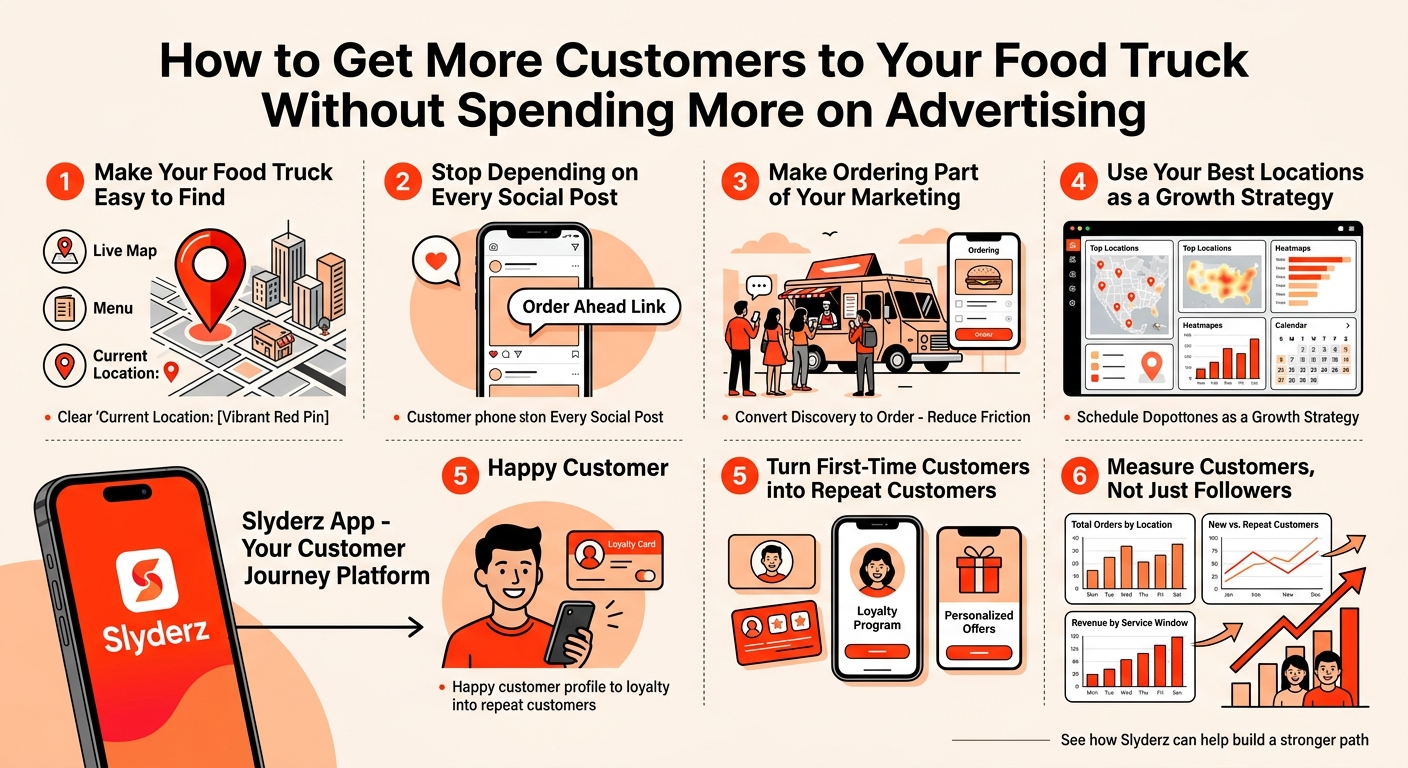
1. Make Your Food Truck Easy to Find
A customer cannot order from a food truck they cannot find.
For mobile businesses, location is more than an operating detail. It is a marketing asset.
Customers need to know where the truck is, when it will be there, whether it is currently open, and what they can order. If that information is spread across multiple social posts, outdated websites, and different platforms, customers have to do the work themselves.
That creates unnecessary friction.
A stronger approach is to make your current location, hours, menu, and ordering options available in one clear digital experience.
For example, instead of asking a customer to search through Instagram for today's location, the customer should be able to quickly see:
Today's location: Downtown Atlanta
Hours: 11:00 AM–3:00 PM
Menu: Available now
Order: Order ahead
The goal is not simply more visibility. It is visibility that leads somewhere.
2. Stop Depending on Every Customer Seeing Your Social Post
Social media should be part of a food truck marketing strategy, but it should not be the entire strategy.
Toast recommends that food trucks use social platforms to communicate locations, events, promotions, and menu updates. It also emphasizes the importance of having clear business information and links to menus or ordering.
The distinction is important.
A social post can tell someone where you are. A connected ordering experience can help that person take the next step.
Think of the difference between:
"We're at Piedmont Park today!"
and:
"We're at Piedmont Park today. View the menu and order ahead."
The second message gives the customer a path to purchase.
That means the objective of marketing should not simply be more followers, likes, or views. It should be turning attention into measurable business activity.
3. Make Ordering Part of Your Marketing
Getting someone interested in your food is only the first step.
The next question is how easily that interest becomes an order.
The National Restaurant Association's 2025 Off-Premises Restaurant Trends report found that 47% of adults pick up takeout at least once a week, while 57% of adults had recently used mobile ordering. The report also identifies speedy service and intuitive technology for ordering and paying as key attributes for off-premises customers.
For food trucks, that creates an opportunity to turn digital discovery into digital ordering.
Consider an illustrative example.
A truck has 50 people discover its social content during a weekday lunch period. If those customers have to remember the location, find the menu, wait in line, and figure out how to pay, every additional step creates an opportunity to lose the sale.
Now imagine those same customers can immediately view the menu and order ahead.
The exact increase in sales will depend on the truck, its location, menu, staffing, and customer behavior. But the principle is straightforward: reducing the number of steps between discovery and purchase can reduce friction.
4. Use Your Best Locations as a Growth Strategy
Not every location produces the same result.
A food truck might perform well near an office district during lunch but struggle in the same area on a weekend. Another truck might generate stronger sales at festivals, breweries, apartment communities, or recurring local events.
That makes location data valuable.
Instead of treating every service period equally, operators can track metrics such as:
- Orders by location
- Revenue by day and time
- Popular menu items by location
- Average order value
- Repeat customer activity
- Order volume during promotions
The objective is to identify patterns.
For example, if an operator discovers that a particular location consistently produces higher order volume during a specific lunch window, that information can influence future scheduling.
Location becomes more than a place to park the truck. It becomes part of the growth strategy.
Toast similarly describes location as a key marketing consideration for food trucks because mobile businesses need to communicate where customers can find them and choose locations strategically.
5. Turn First-Time Customers Into Repeat Customers
Acquiring a new customer is only part of the equation.
The stronger long-term opportunity is getting that customer to come back.
A customer who discovers a truck at an event today could become a regular customer next month—but only if the business gives them a reason and an easy way to return.
That could include:
- Loyalty rewards
- Personalized promotions
- New-menu announcements
- Upcoming location alerts
- Order history
- Direct customer communication
The National Restaurant Association's 2025 research identifies loyalty programs and value offers among the attributes that influence off-premises purchasing decisions.
For food truck operators, this means marketing should not end when the transaction is complete.
The first order can become the beginning of the customer relationship.
6. Measure Customers, Not Just Followers
A larger audience does not automatically mean a larger business.
Food truck operators should connect marketing activity to business outcomes wherever possible.
Instead of only asking:
"How many people saw our post?"
ask:
"How many people discovered us, visited us, ordered, and came back?"
That shift changes how operators evaluate marketing.
A simple dashboard might track:
Discovery → How many people viewed or found the truck?
Conversion → How many placed an order?
Average order value → How much did each customer spend?
Retention → How many customers ordered again?
Location performance → Where and when did the strongest sales occur?
These metrics give operators a clearer picture of what is actually driving revenue.
Growth Doesn't Always Require a Bigger Ad Budget
More advertising can increase awareness, but it is not the only way to grow.
For food trucks, some of the biggest opportunities are operational: being easier to discover, communicating location clearly, reducing ordering friction, and creating stronger reasons for customers to return.
The National Restaurant Association reports that digital orders represented 16% of foodservice orders in 2023, more than triple the 5% share before the pandemic.
That shift reinforces an important point for food truck operators: digital ordering is no longer simply an additional convenience. It is increasingly part of how customers interact with food businesses.
Slyderz is built around that customer journey.
Instead of treating discovery, location, ordering, payments, and customer relationships as separate pieces, Slyderz brings them together in one platform built for mobile food businesses.
The goal is simple: help food truck operators turn more of the attention they already earn into actual orders and repeat customers.
See how Slyderz can help your food truck build a stronger path from discovery to order.
No comments yet